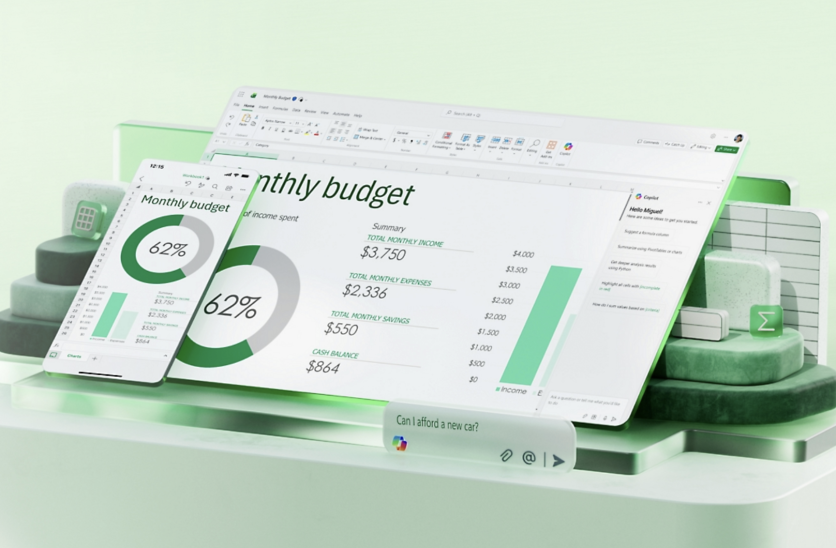
Microsoft's Build 2026 conference produced the year's biggest enterprise-AI announcement, and the piece with the widest reach is also the most concrete: Anthropic's Claude is now an option in Excel Agent Mode, dropping a frontier AI model straight into the spreadsheet used by an estimated 750 million people worldwide, according to a roundup of the June 8 news.
The Excel hook sits inside a far larger move. Microsoft's Foundry model catalog now holds more than 11,000 models — frontier closed-weight models from OpenAI, Anthropic, and Google, Microsoft's own MAI family, and thousands of open-source and specialized models — all reachable through one Azure endpoint and one billing relationship.
What Claude In Excel Actually Does
The capability is the story. Excel users can invoke Claude to write and explain formulas, clean and transform messy data, generate written analysis of what a sheet shows, and build automated workflows — without leaving the spreadsheet. For the enormous population whose actual job is a workbook, that collapses the distance between "I have data" and "I have an answer I can explain in the meeting."
It does not stop at Excel. Anthropic's models extend into Microsoft 365 Copilot Researcher and Copilot Studio custom agents, with Claude Sonnet 4.5, Haiku 4.5, and Opus models available in Foundry through standard Azure authentication, billing, and SDKs for Python, TypeScript, and C#. The spreadsheet is the consumer-facing edge of a much deeper enterprise plumbing job.
The Pricing Wrinkle
There is a meter running. Microsoft is charging for Copilot AI usage based on token consumption — a model Forrester's Ken Parmelee called "the new gateway drug." That phrase captures the tension neatly: dropping Claude into Excel is genuinely useful, and it is also a metered service whose cost scales with how much you rely on it. The more indispensable it becomes to your workflow, the more it bills you for the privilege. Worth knowing before a team wires it into every recurring report.
Why It Matters For You
For most people, "Claude on iPhone" and "11,000 models in Foundry" are abstractions. "Claude inside Excel" is not. It lands a top-tier AI model in the single most widely used analytical tool on Earth, where the payoff is immediate and the learning curve is close to zero. For Anthropic, it is distribution into hundreds of millions of workdays as the company finalizes its IPO. For Microsoft, it is one more reason the work — and the billing — never leaves Azure. The quiet winner is whoever owns the surface where the work already happens.
Bottom Line
The loudest AI headlines this week were about phones and frontier models, but the one that reaches the most desks is Claude in Excel Agent Mode. It turns a spreadsheet into something you can interrogate in plain language, backed by a frontier model — with a token meter attached. Useful, immediate, and quietly the most consequential AI deployment of the week for ordinary office work.
Frequently Asked Questions
What is Claude in Excel Agent Mode? An integration, announced at Microsoft Build 2026, that lets Excel users call Anthropic's Claude inside the spreadsheet to write and explain formulas, clean data, generate analysis, and build workflows.
How many people could it reach? Excel is used by an estimated 750 million people worldwide, making it one of the largest distribution surfaces any AI model has been embedded into.
What is Microsoft Foundry? Microsoft's enterprise AI platform, whose catalog now exceeds 11,000 models — including Claude, GPT-5.5, Gemini, and Microsoft's MAI — accessible through one Azure endpoint and billing relationship.
Does it cost extra? Yes. Microsoft charges for Copilot AI usage based on token consumption, so cost scales with how heavily you use it.
ⓒ 2026 TECHTIMES.com All rights reserved. Do not reproduce without permission.


