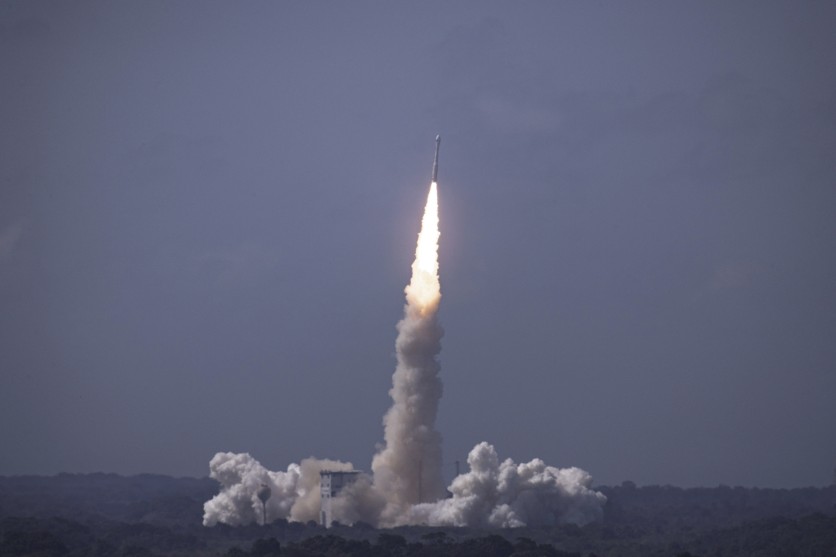
At 05:52 CEST on May 19, 2026, a Vega-C rocket lifted off from Europe's Spaceport in Kourou, French Guiana, carrying the Solar wind Magnetosphere Ionosphere Link Explorer — SMILE — into a parking orbit 707 kilometers above Earth. By 06:49 CEST, ESA's New Norcia ground station in Australia had confirmed the spacecraft's solar arrays were generating power and the mission was declared a success. For anyone who depends on electricity grids, GPS navigation, satellite communications, or financial systems that rely on precise timing signals, the launch matters: SMILE is the first satellite ever built to photograph Earth's magnetic shield in X-ray light, giving space weather scientists the global view they have been working toward for seven decades.
The Observation Gap That Has Stood Since the Space Age Began
Earth's magnetosphere — the vast magnetic bubble that deflects the continuous stream of charged particles from the Sun — has been studied since the 1950s, but always from single points. Every previous spacecraft measured conditions at its own location, like a weather station that can only report what is directly overhead. To understand a storm system as a whole, you need to see it whole. SMILE is designed to do exactly that.
The satellite carries four instruments into an extreme operational orbit, which it will reach over the next month via 11 engine burns: a highly elliptical path that takes it 121,000 kilometers above the North Pole — roughly one-third of the distance to the Moon — where it will spend the bulk of each 48-hour orbit staring at the full magnetospheric system, before descending to 5,000 kilometers above the South Pole to transmit its data. Science operations are scheduled to begin in July 2026, after the instrument booms are deployed and the camera covers opened.
Two of its four instruments are unprecedented in this application. The Soft X-ray Imager, developed by the University of Leicester with contributions from Mullard Space Science Laboratory and the Open University, uses micropore optics derived from XMM-Newton telescope technology to detect the faint X-ray glow emitted when charged solar wind particles collide with neutral gas at the edge of the magnetosphere — a process called solar wind charge exchange. The result is a real-time map of the magnetopause: where it is being compressed, where it is flexing, and how its shape changes as solar conditions vary. No instrument has ever produced this view before.
The Ultraviolet Imager will record the full auroral oval — the ring of light around the North Pole produced when energetic particles thread through Earth's magnetic field — continuously for up to 45 hours at a stretch. That is the first sustained full-oval ultraviolet coverage since 2008. The remaining two instruments — a Light Ion Analyser and a Magnetometer — measure the charged particle environment and local magnetic field at SMILE's position, providing in-situ ground truth to calibrate the remote imaging data.
Together, these four instruments allow scientists to simultaneously watch the Sun's energy arrive at the magnetopause, track how the boundary deforms, and observe the auroral response at the poles — the full chain of cause and effect in a single observation window.
Three Questions That Have Resisted Seven Decades of Research
SMILE's science case is built around three problems that decades of single-point measurements have been unable to resolve.
The first is the behavior of the magnetopause under solar wind pressure. The boundary flexes, ripples, and occasionally allows solar wind to breach it through a process called magnetic reconnection, but how and when this happens across the full boundary extent remains poorly understood. SMILE's X-ray camera will capture the complete magnetopause geometry in each image frame.
The second is what triggers substorms — the episodic snapping of Earth's stretched magnetotail on the night side, which releases stored energy toward the poles and drives the most intense surface-level geomagnetic disturbances. The trigger mechanism for these events remains one of the central unresolved questions in magnetospheric physics.
The third, and most immediately consequential for infrastructure, is whether global imaging of the magnetosphere can improve the accuracy and lead time of geomagnetic storm forecasts. Today, NOAA's primary space weather monitoring satellite — DSCOVR, stationed at the gravitationally stable L1 point 1.5 million kilometers sunward of Earth — provides 15 to 60 minutes of warning before solar wind reaches Earth, measured as it passes the spacecraft. The limitation is structural: DSCOVR is a single-point sensor. It measures what passes directly by it. It cannot show the shape or extent of the pressure front bearing down on Earth's magnetosphere, or predict how that structure will interact with the magnetic field it hits. SMILE's X-ray frames could, in principle, provide that geometry. Whether forecasting agencies at NOAA and equivalent organizations will be able to integrate SMILE data into operational forecast models — and on what timeline — remains to be demonstrated. That is the practical test that will determine whether this satellite changes the warning picture for power grid operators and satellite managers.
A €130 Million Collaboration That No U.S. Agency Could Replicate
SMILE is the first space mission jointly selected, designed, built, launched, and operated by the European Space Agency and the Chinese Academy of Sciences. ESA's financial contribution is €130 million, involving more than 40 companies and institutes across 14 European countries, with the largest contributions from the United Kingdom and Spain. Airbus Defence and Space in Spain built the payload module. The University of Leicester led development of the X-ray camera. CAS contributed the spacecraft platform, three of the four science instruments, and shares operational responsibility with ESA through coordinated ground segments: data flows both to ESA's Science Operations Centre at the European Space Astronomy Centre in Madrid, and to the CAS Space Science Data Center in Beijing's Huairou District, as well as the Sanya ground station in China.
The collaboration is a direct consequence of a cooperation framework ESA and CAS have built over 25 years, and it highlights a structural divide in Western space policy. Since 2011, NASA has been prohibited by the Wolf Amendment from entering bilateral cooperation with the government of China or Chinese-owned entities without specific congressional authorization. The ESA-CAS SMILE mission is precisely the kind of heliophysics collaboration that legal restriction prevents on the American side. NASA scientists may access SMILE data once it is publicly released, but the agency was not a development partner.
ESA Director General Josef Aschbacher described the mission as a demonstration of what the 25-year partnership can deliver. "We are about to witness something we've never seen before — Earth's invisible armour in action," he said following the launch confirmation. "With SMILE, we are pushing the boundaries of science in an effort to answer big questions that have remained a mystery since we discovered, over seventy years ago, that Earth sits safely within a giant magnetic bubble."
What Is at Stake for Infrastructure
The practical case for this science is not abstract. Geomagnetic storms damage transformers, disrupt GPS timing signals, degrade satellite communications, expose airline crews and passengers on polar routes to elevated radiation, and generate geomagnetically induced currents that can interfere with pipelines and undersea cables. The 1989 geomagnetic storm collapsed Hydro-Québec's power grid in under 90 seconds on March 13, cutting electricity to approximately six million people for nine hours. A National Academies of Sciences report estimated that a storm matching the 1859 Carrington Event's scale today could cause approximately $2 trillion in damage in the United States alone, primarily from transformer destruction and extended outages lasting months.
Better physical models of how storms develop and propagate through the magnetosphere are a prerequisite for pushing warning times beyond the current window. SMILE's project scientist Philippe Escoubet framed the downstream goal plainly: the science the satellite uncovers "will improve our models of Earth's magnetic environment, which could ultimately help keep our astronauts and space technologies safe for decades to come."
The satellite will spend the next three years systematically observing the boundary where the Sun's continuous output meets Earth's magnetic defense. Each X-ray image it returns will be the first of its kind. The physics it illuminates has been waiting, unanswered, since the instruments capable of addressing it finally became technically feasible. They launched this morning.
ⓒ 2026 TECHTIMES.com All rights reserved. Do not reproduce without permission.


