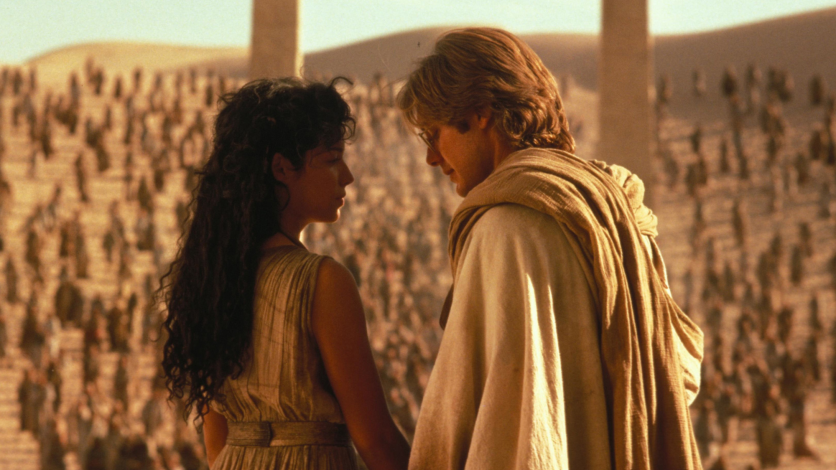
Just four days after killing the planned Martin Gero revival, Amazon MGM Studios is weighing a hard reboot of the Stargate franchise — one that would abandon more than two decades of established television canon and start over entirely. According to the Tachyon Pulse podcast, the hard reboot is now the most likely direction for the property under Amazon's ownership. A second option reportedly on the table would skip the TV canon entirely and deliver a direct sequel to the original 1994 Roland Emmerich film, potentially bringing back Kurt Russell and James Spader as Colonel Jack O'Neil and archaeologist Dr. Daniel Jackson.
Neither path has been confirmed publicly. Amazon has not issued any statement. But the speed at which these options materialized — within days of cancelling a project its own executives had greenlit just seven months earlier — signals that the studio is moving fast on a franchise it is not willing to leave dormant.
An online petition calling for the reinstatement of Gero's cancelled series had gathered more than 60,000 signatures as of June 7, 2026.
Martin Gero's Revival: What Was Cancelled and Why
Amazon MGM greenlit the Gero revival in November 2025. Gero — a franchise veteran who had written for both Stargate: SG-1 and Stargate: Atlantis, and who later created NBC's Blindspot — described his attachment to the property in terms that made his intentions unmistakable. "Twenty years ago, my first real job in television was as a story editor on Stargate: Atlantis," he said at the announcement. "I spent five years at the franchise working across all three series, Stargate taught me everything about making television — it's written into my DNA."
The project spent nearly 20 weeks in the writers' room developing a continuation set within the existing universe. Brad Wright and Joseph Mallozzi — two of the architects of the franchise's television run — were attached as consulting producers. Dean Devlin and Roland Emmerich, who co-wrote and directed the 1994 original, were executive producers.
Amazon pulled the plug on June 3, 2026. According to Variety, the studio's executives had concluded that Gero's approach "would not have broad appeal beyond the franchise's already dedicated fanbase." Deadline reported that a leadership regime change at Amazon MGM contributed to the decision: two key executives who had championed the project — Nick Pepper and Matt King — had both left the company, and incoming leadership determined that Gero's vision "no longer aligned with Amazon's programming strategy."
Mallozzi pushed back publicly on X, writing within hours of the cancellation: "Nope. No. Sorry. Gonna have to push back on this. We were ever mindful of creating a show that would have broad appeal." Michael Shanks, who played Dr. Daniel Jackson across multiple series, went further, warning fans this may be the last opportunity to see the original creative team and cast involved. "If you are at all interested in a Stargate show with ANY of the original creators/performers involved, now is the time to say something. Otherwise it really will be the end of that chapter forever," he wrote publicly.
Hard Reboot vs. 1994 Sequel: What Each Path Erases
The two options now under consideration represent fundamentally different bets on the franchise's value.
A full hard reboot would clear the decks entirely: no reference to the 15-plus seasons of television content, no established characters from SG-1, Atlantis, or Stargate: Universe, no continuity with the mythology built across those three series and two direct-to-video films. The creative team would start from the premise of the original film and build outward — with new characters, new canon, and no obligation to the existing history.
The 1994 sequel option is narrower in scope but similarly detached from television continuity. Russell's O'Neil and Spader's Daniel Jackson exist in a separate canon from the television versions — in the TV universe, Richard Dean Anderson played a different iteration of the character, spelling the surname with two l's. A direct sequel to the Emmerich film could effectively position itself as a fresh start without the structural burden of contradicting fifteen-plus years of overlapping continuity.
The bet Amazon is apparently making in either case is the one it already made when cancelling the Gero revival: that the franchise's existing fanbase is a constraint on growth rather than a foundation for it. That is, explicitly, the logic the Nu-Trek strategy at Paramount+ deployed — rebooted Star Trek entries, including J.J. Abrams' 2009 film, were deliberately engineered to draw in viewers unfamiliar with decades of canonical history.
What Stargate's Canon Actually Contains: A 25-Year Asset
The property that a hard reboot would discard is not a minor one. Stargate: SG-1 launched in 1997 and ran for ten seasons — first on Showtime, then on the Sci Fi Channel — making it one of the longest-running North American military sci-fi series in television history. Stargate: Atlantis ran five seasons from 2004 to 2009. Stargate: Universe, the franchise's darker, more serialized entry, aired two seasons on Syfy before its cancellation in 2011. Between them, the three series built a mythology spanning ancient alien civilizations, multiple galaxies, and a recurring cast of characters across nearly 400 episodes.
The franchise's enduring appeal rests partly on a premise that has more theoretical physics behind it than most science fiction ever acknowledges.
Stargate Wormhole Physics: Exotic Matter Requirements Block Every Known Production Route
The central device of the franchise — an ancient alien ring that connects two points in space through a stable tunnel — maps onto a class of solutions in general relativity that physicists call traversable wormholes. The physics is real. The engineering requirements are the problem.
The foundational framework comes from a 1988 paper by Michael Morris and Kip Thorne — the latter of whom later won the 2017 Nobel Prize in Physics for gravitational wave detection. Their work asked a precise question: given the known laws of physics, what would a traversable wormhole actually require? The answer was specific. To hold a wormhole throat open — to prevent spacetime from collapsing the tunnel back on itself — the geometry demands "exotic matter": a substance with negative energy density that violates what physicists call the null energy condition. Classical matter cannot supply this. Nothing in the Standard Model of particle physics does.
There is, however, a real physical effect that produces negative energy density: the Casimir effect. When two uncharged conducting plates are placed extremely close together, the restriction of which quantum vacuum fluctuations can exist between them creates a measurable negative energy density in that gap. The effect is real and has been measured in the laboratory. It is, in fact, the only known experimentally confirmed source of exotic matter. The problem is scale: the Casimir effect produces negative energy in quantities on the order of 10^40 times too small to sustain a wormhole throat large enough for a human to pass through.
More recently, Juan Maldacena of the Institute for Advanced Study and Alexey Milekhin published a paper in Physical Review D calculating what a humanly traversable wormhole might look like under a higher-dimensional spacetime model. Their result was not encouraging for franchise fans: the wormhole throat would need to be roughly the size of the Earth, with gravitational forces approximately 20 times greater than Earth's surface gravity. The transit time as observed from outside would be approximately 20,000 years, though the traveler would experience it as nearly instantaneous due to extreme spacetime distortion.
The Stargate franchise's device does not engage with these constraints. Its 38-minute maximum wormhole duration, its flat-face aperture geometry, and its matter dematerialization-and-reconstruction mechanism are narrative solutions to physics problems, not engineering ones. What the franchise does unusually well is use a physically motivated premise — general relativistic spacetime topology — as the foundation for a mythology rather than treating faster-than-light travel as a black box. A reboot that discards the accumulated world-building would inherit this premise but not the 25 years of context that has made it resonate with a technically engaged audience.
"Broad Appeal" and the Nu-Trek Comparison
Amazon's stated rationale — concern that the show would appeal only to existing fans — has been challenged directly by the people who built the cancelled project. Mallozzi argued that the creative team had designed the series for both new and existing viewers. The petition language reflects a similar counterargument: a proven fanbase is not a liability, it is an audience that has already demonstrated it will commit.
The Nu-Trek comparison Amazon is apparently using as a strategic model has a mixed record. The Abrams-era films were commercially successful, drawing audiences unfamiliar with the prior television canon. Later series had more complicated trajectories, with some attracting vocal criticism from long-term franchise fans while the entries that leaned into existing canon received more positive reception from that same group.
Whether a Stargate hard reboot would follow the Abrams trajectory or a more troubled one is not knowable in advance. What is determinable is that the choice forecloses the alternative: a reboot that succeeds on its own terms does not automatically preserve the canon, and a reboot that fails leaves both paths closed.
Frequently Asked Questions
Why did Amazon cancel the Stargate revival?
Amazon MGM Studios cancelled the Martin Gero revival in June 2026, citing concern that the series would not attract audiences beyond the franchise's existing fanbase. A simultaneous leadership change at the studio — with the two executives who had backed the project having left the company — meant that incoming leadership did not support the direction Gero had developed over nearly 20 weeks in the writers' room.
Will Stargate come back?
Amazon MGM Studios has not confirmed any future direction for the franchise. According to the Tachyon Pulse podcast, the studio is considering either a full hard reboot that would discard the existing television canon, or a direct sequel to the original 1994 film potentially starring Kurt Russell and James Spader. Neither path has been officially announced.
Is Amazon making a new Stargate show or movie?
As of June 2026, Amazon has not announced a new Stargate project. The studio is reported to be actively considering its options following the cancellation of the Gero revival, with a hard reboot or a 1994-film sequel among the possibilities under internal discussion.
What happened to Martin Gero's Stargate project?
Amazon MGM cancelled Martin Gero's Stargate revival in June 2026, after the creative team spent nearly 20 weeks developing the series in the writers' room. Gero, a franchise veteran with writing credits on SG-1 and Atlantis, had designed the show as a continuation of the existing universe rather than a reboot. Franchise veterans Joseph Mallozzi and Michael Shanks publicly disputed Amazon's stated rationale for the cancellation.
ⓒ 2026 TECHTIMES.com All rights reserved. Do not reproduce without permission.


